- Λεπτομέρειες
- Dimitris Troaditis
- English
The first trade union in Egypt under the name Brotherhood of Workers founded in 1872 by Greek workers, most of which came from the island of Corfu.
The first anarchist publication in Egypt appeared in Alexandria, probably in 1877 with the title «Il Lavoratore» («The Worker") in Italian language.
In September 1878, Errico Malatesta leaves Naples to avoid internment. He goes to Alexandria, Egypt where there is a thriving community of Italian workers. Meanwhile, after King Umberto I assumes the throne of Italy, the republican Passamante unsuccessfully attempts to assassinate the new king. There is widespread repression throughout Italy, in particular, against the anarchists. A meeting of Italian patriots organized in Egypt to decry the act of Passamante, and in response the Italian workers begin to organize a demonstration in front of the Italian Consulate to salute Passamante and oppose the Italian patriots. Before this can take place however, Malatesta is arrested along with Alvina and Parini. Malatesta and Alvina are both deported. Parini though a native of Leghorn, was a long time resident of Egypt and managed to stay there.
Another Italian anarchist, Amílcare Tsipriani is arrested and imprisoned in Italy in 1881 for the killing of an Italian in Alexandria in 1867. This incident was previously ruled self-defence but was invoked by the Italian authorities to put Cipriani out of commission when during his revolutionary campaigning in 1881. Cipriani's imprisonment becomes a celebrated case across the left. Cipriani remained for a quite long time in Greece.
On April 1, 1882, Egyptian charcoal workers began a strike (the first in the history of the country) against Suez Canal at Port Said company. The strike had strong anarchist participation, perhaps incitement.
During the same year the President of the Italian Workers Association in Alexandria sent a letter to the new government under Prime Minister Sami Pasha al-Barudi supporting the insurrection of Ahmad Orabi and denouncing foreign intervention.
In 1884 an anarchist review appeared under the title«La Questione Sociale» (“The Social Question"), in Italian language.
In 1890, the Patenta law is passed effectively ending the guild system in Egypt. The effect of this is a boost to labor activity in the country.
On 18 March 1894, the Egyptian Newspaper, Al-Hilal, reports the arrest of a Greek worker in Alexandria for distributing what the police call "anarchist leaflets". The leaflets call for workers to celebrate the anniversary of the Paris Commune and ends "Long Live Anarchy." (or "Long live Communism" according to another translation.) On October 1 1894 Greek workers employed by the Suez Canal Company go on strike. Sakellaridis Yannakakis establishes a shoemakers union. Greek physician Dr. A. Skouphopoulos is another well known agitator in this region. Under his leadership the International Labor Union of the Isthmus of Suez founded in 1918 after also an initiative of Mutual Brotherhood "The Phoenix", which was founded in 1908. Also in 1923 in Alexandria Skouphopoulos’ work "Old and New Ideas” released.
On October 1, 1894, Greek workers employed in Suez Canal went on strike with...
- Λεπτομέρειες
- Ομάδα Αναρχοσυνδικαλιστών
- English
An English translation of a historical (early 1980s) Greek anarchosyndicalist text by the Anarchosyndicalists Group, also available as PDF and OpenDocument. The Greek original is at http://athens.indymedia.org/front.php3?lang=en&article_id=204256
The Anarchosyndicalists’ Group
Early 1980s, Greece
Translated 2009
Translator’s foreword
For the first time this historical and hard-to-find document of the Greek anarchosyndicalist movement is presented in English: the ‘Revolutionary syndicalism and organization’ (‘Επαναστατικός συνδικαλισμός και οργάνωση’) was printed in the early 1980s as a small brochure in polytonic Greek (then the standard form of written language) by the Anarchosyndicalists’ Group (Ομάδα Αναρχοσυνδικαλιστών), an organization active during 1980–1982 in Athens, Greece. This profound...
- Λεπτομέρειες
- Jack Ray
- English
A short history of the Andartiko, Greek Resistance partisans who fought fascist occupation. This article is highly uncritical and we disagree with some of it but reproduce it here for reference.
Its radical, democratic working class spirit was only put down after the Allied victory, by British forces and the Greek ruling class.
Nowhere in Europe was resistance as simple as good guys in the hills with rusty rifles, and bad guys wearing swastikas and burning villages, but Greece was particularly complex. Even the Italian decision to invade seems bizarre, motivated by a desire to counter German influence in Rumania....
- Socialist, anarchist and revolutionary movements in Patras in 1880s
- The Democratic Association of People in Patras and the newspaper “Hellenic Democracy”
- Stavros Kouchtsoglous - A Greek anarchist communist with anarchosyndicalist ideas
- Social radicalism in Greece - Part 1: Reformists - Utopians – Anarchists
- Greece: War and Civil War
- Stelios Arvanitakis and the Communist Union of Greece
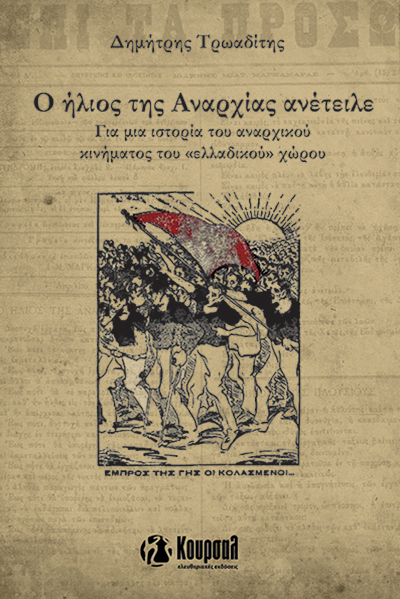
- “Epi ta Proso” (“Forward”) – 1890s - A Greek anarchist collective-newspaper

Στο κτήριο της Ελληνικής κοινότητας της Μελβούρνης στις 18/07/2019
Με τον Ελευθεριακό στο Αυτοδιαχειριζόμενο Στέκι Πέρασμα, 22/01/2018